
Why Is It Important To Create A Social Learning Environment Within An Organization, And What Are Effective Strategies For Doing So?
Learn about the benefits to using social media tools for social learning within your organization.
An evolving role
“THE LEARNING ENVIRONMENT FRAMEWORK WAS CONCEIVED AS A WAY OF THINKING ABOUT HOW TO BEST MEET EMERGING LEARNING NEEDS IN A FAST-PACED ENVIRONMENT.”
“The role of a talent development professional in the digital age is clearly changing. While instructional design may be called for in some instances, we can more efficiently and effectively meet learning needs by helping learners to take advantage of materials and activities that already exist. We need to help people to align a wide range of learning activities toward a defined end—knowledge and skill develop- ment in a particular area. An effective learning environment provides both a rich range of resources and the kind of scaffolding and guid- ance that people need to manage their own learning. Designing learning environments is a modern way for talent development professionals to provide valuable support for learning.”
CATHERINE LOMBARDOZZI, 2016
https://eds.a.ebscohost.com/eds/pdfviewer/pdfviewer?vid=6&sid=2ddd2122-6b84-4474-8e1b-35bfc64f3c06%40sdc-v-sessmgr02
Social Learning
Social learning can enhance the skills and knowledge of employees within your workforce through the sharing of information and learning tools.
What is Social Learning?
According to Alchemer
Social learning is cognitive learning theory that suggests people learn from each other by watching them, imitating them, and modeling them.
“Most human behavior is learned observationally through modeling: from observing others one forms an idea of how new behaviors are performed, and later on occasions, this coded information serves as a guide for action.” – Albert Bandura
Benefits to Social Learning
The benefits of using social media for collaboration is time and location. It’s a great way to reach employees who might be geographically separated or work in different shifts and get them to participate as one group. Also, if they can engage at a time that’s convenient for them then the quality of engagement is more likely to go up. Some of the disadvantages to using social media for collaboration is the obvious technical difficulties or frustration from those who are not used to engaging in this type of forum.
Choosing the Right Method
When choosing the most appropriate social media tool for learning the best method is to “(t)ry to meet your learners where they are and take them where your organization wants to go” (Bozarth, 2010, p. 16). Using this method makes the most sense because choosing a tool that your learners are familiar and comfortable with will alleviate the initial distraction of getting everyone logged in or helping them to understand a specific tool that they may not be familiar with. For example, if you have a Facebook group page for your organization and your employees are familiar with this type of communication it might be best to choose this tool for collaboration. If you’re unsure of what type of social media tool your employees are accustomed to using, you could use their demographics combined with your goals to decide. For example, if most of your employees are 50 years old or older, they are more likely to use Facebook or YouTube. If they are younger than 50 years old, then they are more likely to use LinkedIn or Twitter.
“The main benefit of supporting a social learning environment in the workplace is that it enables employees to take responsibility for their own personal learning.”
panopto.com, 2019

Benefits and Improvements to Social Learning
“Typically, employee training occurs through formal, instructor-led channels during prescribed training events. Many times, employees must interrupt their regular duties in order to attend training sessions in a physical location outside of the office — often incurring additional costs for travel and lodging. And simply attending a training session doesn’t guarantee that the learners will retain everything that is taught. A study by Rusted and Coltheart showed that just 30 minutes after finishing a training session, people will remember only 58% of the material taught — and only retain 35% of the material 7 days later.”
panopto.com, 2019
According to a 2015 Study Conducted at the University of Washington’s Information of Technology…
| Teaching & Learning with Social Media at the UW Tara Coffin & Janice Fournier, UW Information TechnologyFor the last several years, the UW has participated in the EDUCAUSE Center for Analysis and Research (ECAR) survey, along with 250 institutions of higher education. Survey results provide insight into UW students’ and instructors’ use of and perceptions about educational technologies compared with their peers at other institutions with doctoral programs. ECAR survey questions differ year to year, and data may not be available every year, for every question. |
| Social Media in Higher Education: OpportunitiesStudents increasingly want their instructors to use social media as a learning tool.want to take advantage of them.. In 2015, 21% of UW students said that they want their instructors to use socialmedia as a learning tool more frequently, compared to 10% in 2012.Instructors should “relate social media and current events on website to our class material.” —UW Student, 2015Instructors underutilize student mobile devices for learning.Students indicate that social media helps them remain connected with their peers and their institution. Social media enables students to build connections with instructors, peers, and campus community—interactions that improve retention rates. Students want to become better at using social media for educational purposes. In 2015, 31% of UW students said they felt they would be more effective if better skilled at using social media as a learning tool, up from 28% in 2014 (p=0.029).More students report using social media as a learning tool in class and for course-related purposes. The percentage of students who indicated that they use social media, or Facebook specifically, as a learning tool increased from 33% of UW students in 2011 to 56% in 2015. |
cultivating
VALUABLE
LEARNING
environments
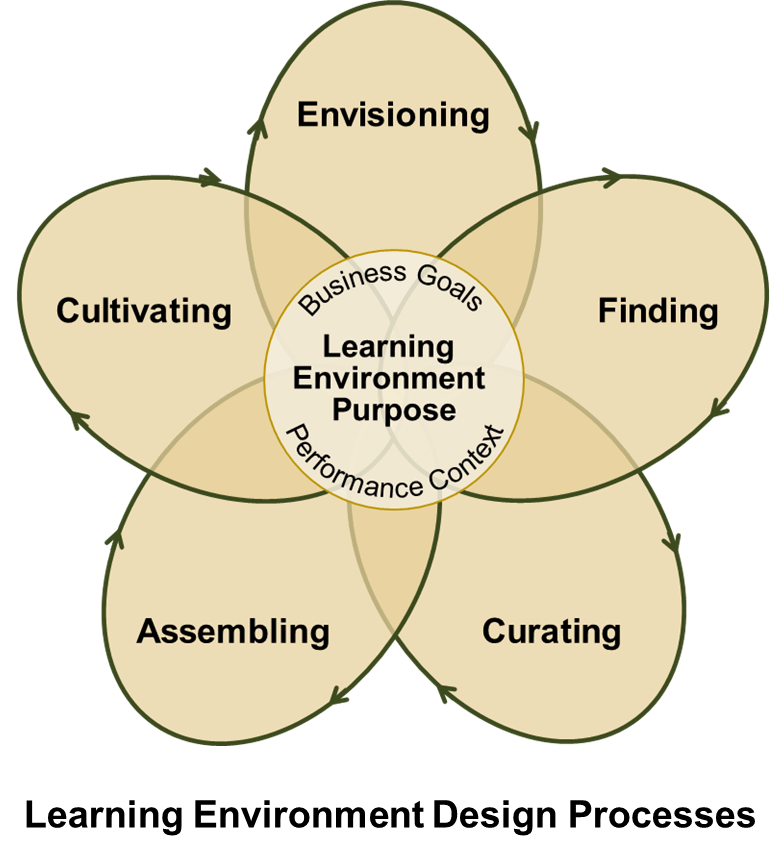
“Consider an organization that is trying
to upskill a large group of people in a par- ticular set of practices and skills (such as Six Sigma management, design thinking, innova- tion, or a company-specific initiative). Talent development leaders could craft a learning en- vironment that focuses on key concepts and skill-building.
In this case, resources might be accessed through an intranet page or social networking space that acts as a learning portal. The portal could link employees to general and company- specific articles, videos, and case studies. It could be a place to share documentation so all might benefit”
BY CATHERINE LOMBARDOZZI, 2016
https://eds.a.ebscohost.com/eds/pdfviewer/pdfviewer?vid=6&sid=2ddd2122-6b84-4474-8e1b-35bfc64f3c06%40sdc-v-sessmgr02
Here are four ideas on how to leverage social learning to improve employee engagement:
- Social learning workshops. Set up regular workshops specific to different skill areas that invite employees from different departments or business functions to come together and learn something new from each other — marketing learns from engineering, for example.
Department A demonstrates an aspect of their role. Department B observes. Department B is then asked to demonstrate or test what they’ve just observed from Department A to determine their comprehension.
Set an average number of social learning workshops an employee should participate in quarterly or annually and include it in their annual performance review so they are incentivized to attend, and they learn new skills and build relationships with more colleagues. Bonus points for the employees who demonstrate how they’ve incorporated the skills shown in these workshops into their regular work. - Position managers as role models. Social learning was founded on the belief that behavior is imitated from a role model. Managers should be consistent with the behavior they’re looking to promote to their employees. When these behaviors are evident to the employee, they should be praised or recognized in some way.
- Set a managerial behavior standard. To avoid unsavory behaviors from managers being promoted and imitated by employees and clearly define what a model behavior is, HR should standardize organizationally acceptable behavior with leadership. These standards should then be communicated at managerial meetings so expectations are set. Deviation from the agreed on behaviors should be accounted for as well.
- Ongoing employee training. Training is a great way to integrate social learning elements throughout the employee experience from new employee training to ongoing training sessions. Social learning encourages training leaders to use role-playing and demonstration, which enliven training and increases its effectiveness, while clearly outlining what is expected from employees. It’s a more interactive way to train employees versus handing them a handbook on day one or asking them to watch an outdated and canned video alone at their workstation.
https://www.alchemer.com/resources/blog/4-ways-social-learning-can-improve-employee-engagement/
Facebook Groups 101: Social Media Tools for Social Learning
Facebook Groups is a social media tool designed for novice instructors with little experience in professional instruction and design who would like to create a learning course for members of their organization. This type of learning platform allows learners in the group to learn from each other through the sharing of information. The administrator or creator is given the option to make the group public, closed, or secret. Using Facebook as an effective social learning tool to create, deliver and monitor training allows the course creator a variety of options. For example, according to Facebook’s Help Center:
“A social learning group is like a regular group except:
- Admins can organize posts into guides and change the order in which they appear.
- Group members can click I am done to let the admin know they have interacted with the guide.
- Admins can view group insights and see details on guide and post completion.”
Users choose Facebook Groups for their training needs due to the efficiency and ease of creating an online training course. The learners also appreciate the ease of being able to self-navigate throughout the course to include the units feature, saving your place throughout the course so you can pick-up exactly where you left off from.
For more information check out the links below:
How To Use Facebook Groups To Grow Your Business – For Coaching and Training
References
Alchemer LLC. (2021). Alchemer. https://www.alchemer.com/resources/blog/4-ways-social-learning-can-improve-employee-engagement/
Bozarth, J. (2010). Social media for trainers. Wiley.
Clark, K. (2018, April 14). Use Your Facebook Group as a Learning Platform (for Training or an Online Course) [https://youtu.be/KKpvzSKHGOM]. YouTube. https://www.youtube.com/watch?v=KKpvzSKHGOM
Garrett, H. (2021). University of Washington Information of Technology. https://itconnect.uw.edu/learn/research/ecar-social-media/
Lambardozzi, C. (2016, January). Cultivating Valuable Learning Environments: A Talent Development Ecosystem . Learning & Development, (), 54-58. https://eds.a.ebscohost.com/eds/pdfviewer/pdfviewer?vid=6&sid=2ddd2122-6b84-4474-8e1b-35bfc64f3c06%40sdc-v-sessmgr02
Meij, S. (2021). Go Skills. https://www.goskills.com/Resources/Benefits-of-social-learning
Panopto. (2021). Panopto. https://www.panopto.com/blog/what-is-social-learning-and-why-is-it-so-important-for-corporate-ld/
Six Figure Mastermind. (2018). YouTube. https://www.youtube.com/watch?v=JK0koyrfht4
Why Is It Important To Create A Social Learning Environment Within An Organization, And What Are Effective Strategies For Doing So?
 Stacie R Brown